Interview date: 20/10/2020 // @jhspedals // jhspedals.info
Where did JHS Pedals begin?
When I first started, I fixed a broken pedal. I modded that pedal as a Boss pedal, and I just got curious. I taught myself schematics and started building classic circuits – it’s a pretty generic story. It’s the Brian Wampler story, the Robert Keely story, and the Jamie Stillman story. You could lay our stories over each other; they’re pretty darn close. It’s a guitar player who is curious enough to be psychotic enough to try to make a pedal, and you know, it worked.
How important do you feel branding is when it comes to launching a new company?
I think the aesthetic and the branding of something matters. I would put it as high as 70% or 80%! In my experience, company branding matters and identity matters. If you step outside of guitar products, I think we buy things because of our identification with a product.
I’m a huge fan of late ’60s and ’70s designs like Paul Rand’s IBM logo, NASA, and all that stuff. Then you get into Nike, and I’m speaking as a crazy American, but I think we all buy things based on the identity of a product, much more than what the product does; I know I bought shoes because they’re Nike, and I just like the way they look.
Shoes are a good analogy; how many people own shoes that are uncomfortable? It’s not about the shoe being a great shoe. I think that applies to guitars as well as pedals. I have really good friends who are much better circuit designers than me, who have done amazing stuff, and they’ll say that their branding and stuff has been off point over the years, or they don’t have that aesthetic eye and don’t do that well. It’s a weird, true, frustrating reality.
How did you develop the JHS logo?
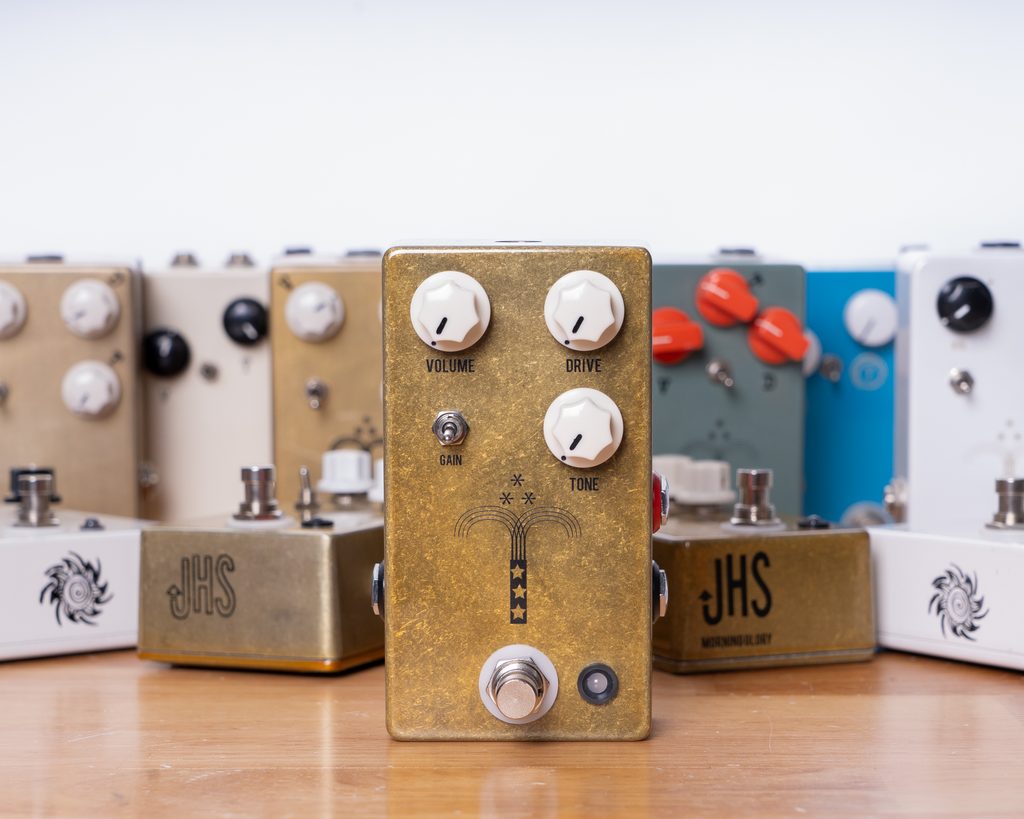
The first JHS logo had a little arrow on the j; that was me modding pedals, knowing I needed a logo because that’s what adults do. But that’s about as far as that thought went. A friend that I knew just picked the font out, and I was like, “Yeah, great”. There was no thought. I remember getting emails, and people would be like, “There’s an arrow on the J pointing up. What does it symbolise?” And, I got that email all the time, and I’d be like, you’re talking about it’s a font like my friend just picked the. That being said, I started seeing that font in restaurant windows. It’s really funny. I’d be in the most random places and see the font.
We started trying to print some merchandise. Picture a baseball cap and put that logo in there; it doesn’t work. And that started raising an eyebrow a little; perhaps that’s not a great logo. It’s fun. So, then we started thinking it through and using common sense.
I love Paul Rand, and I love the minimal. I love typeface logos, and we just reworked it. I just wanted to do something basic. We started using this new logo slowly and thinking, in 50 years, will this work? That’s what Boss has done so well.
Now, this is just my opinion, but I think that illustrative pedal art doesn’t age well. I personally steer as far away from illustrative art. I look at Boss 45 years in, and I’m looking right now at an original Silver Screw CE-2, and It’s the most beautiful thing I’ve ever seen. That pedal was put out in 1978. Now, what is an illustrative pedal with some skeleton-orb-DC-comic image going to look like in 40 years? So, for my company, I don’t want to play that game. So, that logo comes from me knowing that I can look at the NASA logo or the IBM logo, and it’s pure fire, and it’s 50 or 60 years old. And so, I want to be that.
When you’re building an identity, and you have to change your logo, that’s like a cannonball; you have to undo a lot of hard work. So, why not try to have a timeless logo that works, decade after decade, after decade, like the Nike swoosh; it’s perfect. Its typeface and iconography are beautifully done. You look at the Nike swoosh, and 5,000 years from now, when aliens inhabit the Earth, they will look at the Nike swoosh and go, “That’s pretty solid”.

JHS has a distinctive visual style – do you have a background in visual arts?
I have a hard time drawing anything. There’s some kind of picture I drew when I was five. It’s like a Christmas tree with presents everywhere, and my mom turned it into this local news channel. I won a stuffed bear – that’s my only artistic claim. After that, my career as an artist went downhill. I’m not graphically talented in any way. I really struggle with creating what I see in my head. I see very clearly what I want it to look like most of the time, and I’m a big fan of aesthetics.
From the very first moment I modded a Boss pedal, it bothered me that I had to put a sticky label on it. I don’t know why that is, and I don’t have a lot of clarity. I don’t know where that came from. Then, when I started building my home pedals and using blank enclosures, I would see people write on them with paint pens. I was like, “Ah, I have horrible handwriting!” Plus, I think that looks bad. I remember seeing one guy put stickers on his pedal, and that bothered me.
So, I ended up in a craft store. My wife was a children’s teacher, and she was in the craft store, and I saw these stamps on the bottom, like in a metal rack. I walked over, and there was a little orange slice, and I was making a compressor based on the orange squeeze. I was like, ding, light bulb! And I think. I felt perfect; it was the iconography. I didn’t know what iconography was, but I was fully on board at that moment.
Then, the aesthetic thing for me was accidental, in some sense. I found the stamp, but I wasn’t going to write on my pedals with a paint pin. So, there was an accident in finding the stamp, but it’s also not an accident that I didn’t slap a sticker on it or write on it; I was looking for something. I remember I started using the stamps in 2009, and the colours are also a big part of what I have built as a brand, and that was accidental, in some ways.
Now, I understand that more by working with people. I have two graphic designers I’ve always worked with, and I just sit with them and try to get what I see out of my head. I don’t have a hard time with that. We just go through revisions, and they try stuff, and there are times when I’m just like, “I don’t know what the correct icon should be”. I would say 80% of anything we’ve ever released, I had a name and an icon in my head, and then I went and designed the circuit that matched it in an ironic way. So, to me, pedals are a mix of aesthetics, story, and the absurd. You know, it’s like a cartoon aesthetic to me. There was a show I used to watch as a kid called Animaniacs; it’s one of my favourites. It’s a horrible American cartoon by Steven Spielberg, but it feels like that, mixed with Andy Warhol or something.

You are also a bit of a historian and collector of pedals – how important is this to the development of JHS?
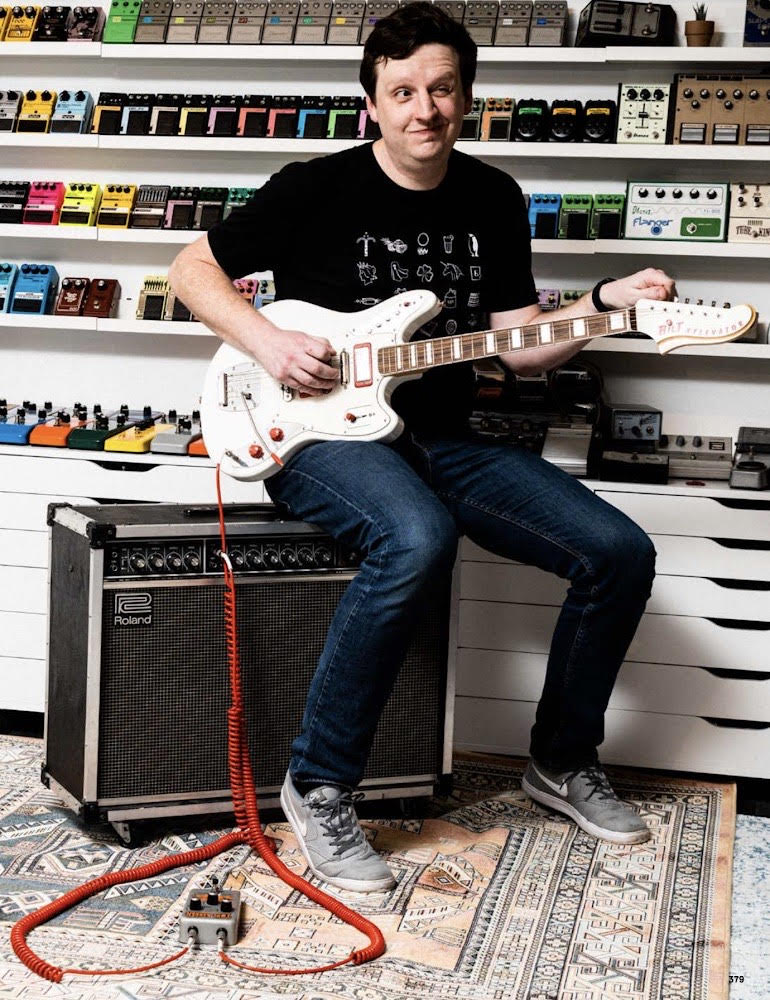
My pedal purchasing process is very mechanical. So, like, I don’t know how much you can see in the room, but you can see a good bit. This room is six feet full, and there are about 4,000 pedals in here. Like all of these, every drawer is full. Now, here’s the honest-to-God truth. There’s really no pedal here that sounds bad. Every pedal does something.
This collection is about archiving these moments in time, these narratives, these stories, and the people who made them. What was the world like when they were made? How did this affect the next thing? How did this come from the thing before? And it’s the storyline of all this that’s fascinating to me. So, I don’t know. I don’t buy a pedal because I think it’s going to sound better than another pedal. I just love the pedals because of the story, which makes me buy things in a totally different way.
Right now, I’m collecting a series called Pearl, a Japanese brand from the 80s. I’m collecting all the Ross pedals from Chanute, Kansas. I’m just getting them because I want the whole set. I want to do an episode or a biography of the sets, and you have to have them all, study them, and interview people like you’re interviewing me.
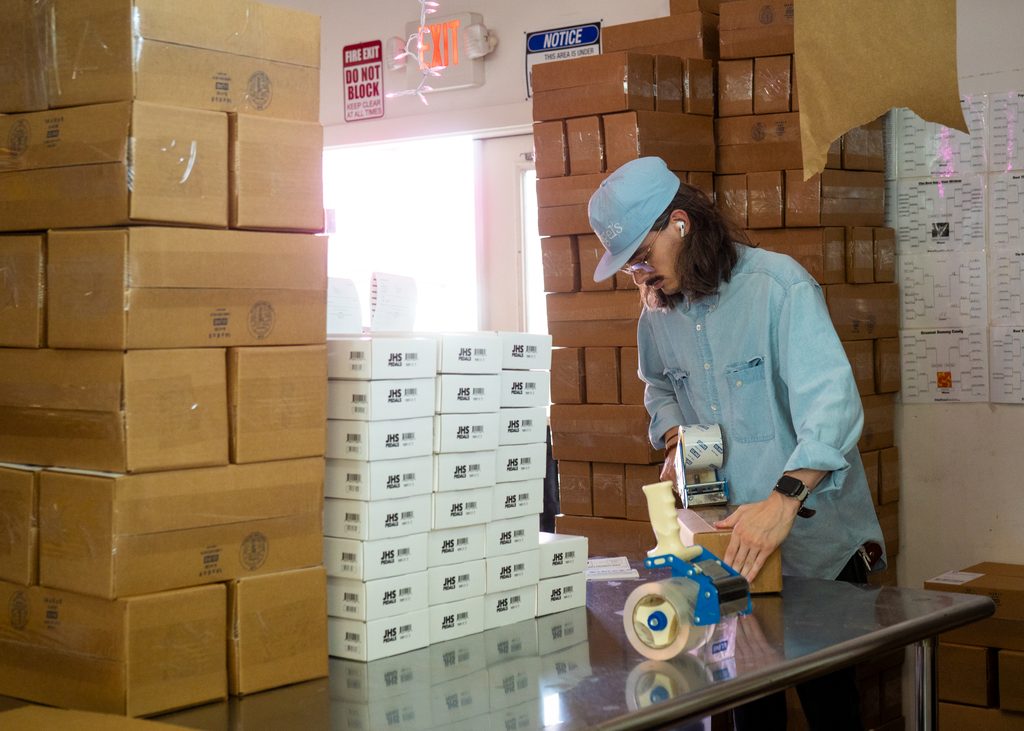
Honestly, it sounds a little crazy, and people might take it wrong, but I really don’t care how pedals sound. That’s just me being really frank. It has nothing to do with my guitar tone. JHS Pedals is a very different part of my brain than this, and I think that’s hard for people to wrap their heads around; it’s just two very different processes.
I spend more time doing this than JHS pedals. I’m constantly researching, writing, working through footage and stuff. So, I see myself evolving into more of a historian. JHS Pedals has 37 employees now, and I do circuit design. I do what a product is, how we sell it, how we talk about it. But really, I don’t just sit around and build pedals. I do this, and it leads to all these ideas of what JHS can do. I feel like I’m always pulling from history for what to do now, what worked, what didn’t. Why did this fail, and what are some lessons to be learned? And I think it’s made JHS a stronger company, understanding 60 years of really good and really bad ideas and having a grasp on history. There’s a cheesy quote about learning from history or something, blah, blah, but, you know, it is real.